Showing posts with label Lohengrinhaus. Show all posts

Friday, 27 June 2014

Wagner's Mysterious Monument in the Woods

Not far from the "Lohengrinhaus" where I've been staying recently and where Wagner sketched out his opera "Lohengrin", there is a monument to the composer - a "Denkmal" as the Germans call it. I suppose that translates as ''thought time".  I needed some Wagner 'thought time". I'd been in the house for a couple of weeks and had not yet connected with the great man in any noticeable way.  I'd imagined myself communing with his spirit in some mystical way. I'd thought, when I walked up the stone steps to the first floor where he stayed,  that I'd have a strong sense of him and Minna  walking up those steps - they'd be weary after a day's hike - ready perhaps for a beer or the fine Saxon wines that he favoured.  Perhaps at night, his ghost would even wander up to my apartment under the eaves for a friendly chat. My German is lousy but I kept a phrase book by my bed just in case he popped in.

But any Wagnerian spirit had failed to show and I was signally failing to commune.  I did hear one lone horn outside the window one warm evening but that was after Germany hammered Portugal 4-0 in the World Cup.  If Wagner approved of that result, he certainly wasn't telling me.

Action was needed. I decided to trace the composer's steps on some of the hikes that he undertook. Time, construction and modern transport have rendered some of his adventures quite banal but there was one that intrigued me. About 45 minutes from the Lohengrinhaus was the Liebethaler Grund -  a "narrow, deeply incised valley of the Wesenitz river" according to its Wikipedia entry.  Since 1933, the biggest Wagner monument in the world was constructed in this dark, dramatic valley that marks the beginning of that remarkable, surreally mountainous region of Saxony known as "Saxische Schweiz" or "Saxon Switzerland". I'd tried once before  to find the monument but I was travelling by car with a German friend and we got nothing but shrugs or dead-end directions. I had, however, seen a signpost pointing to a "Liebethaler Grund" trail so I set out one Saturday afternoon. I walked past the Schloss and past pretty half-timbered houses their English-style gardens opulent with delphiniums, poppies, lupins and loose-strife. I crossed a busy highway and walked along an unpaved road, passing a few more fairly banal modern houses when suddenly, dramatically, the landscape changed.

Massive, craggy brown rocks rose up on either side of the road. Older, wearier looking houses huddled against them. A loud, powerful stream
carved its way through the hamlet. A little bridge led into deep woods. Without thinking I crossed it, headed towards the woods but thought to check with an old man who was passing.  "Sie sind falsch," he replied and my long-forgotten 'o' level German told me I'd gone the wrong way. He pointed back to the main road. I managed to ask if there were a pub or caf in the area. "Not in the east," I understood him to reply. And then I think he added, "They're all dead here." And off he went.

He was right - the little village that had managed to squeeze into the ravine between the rocks had only a few houses. I walked on, asked a fisherman unloading his van and he pointed to another path into the woods, explaining that it was a good 25 minute walk but very beautiful. Then he frowned, thought for a minute and added something else that my German was not fluent enough to understand.

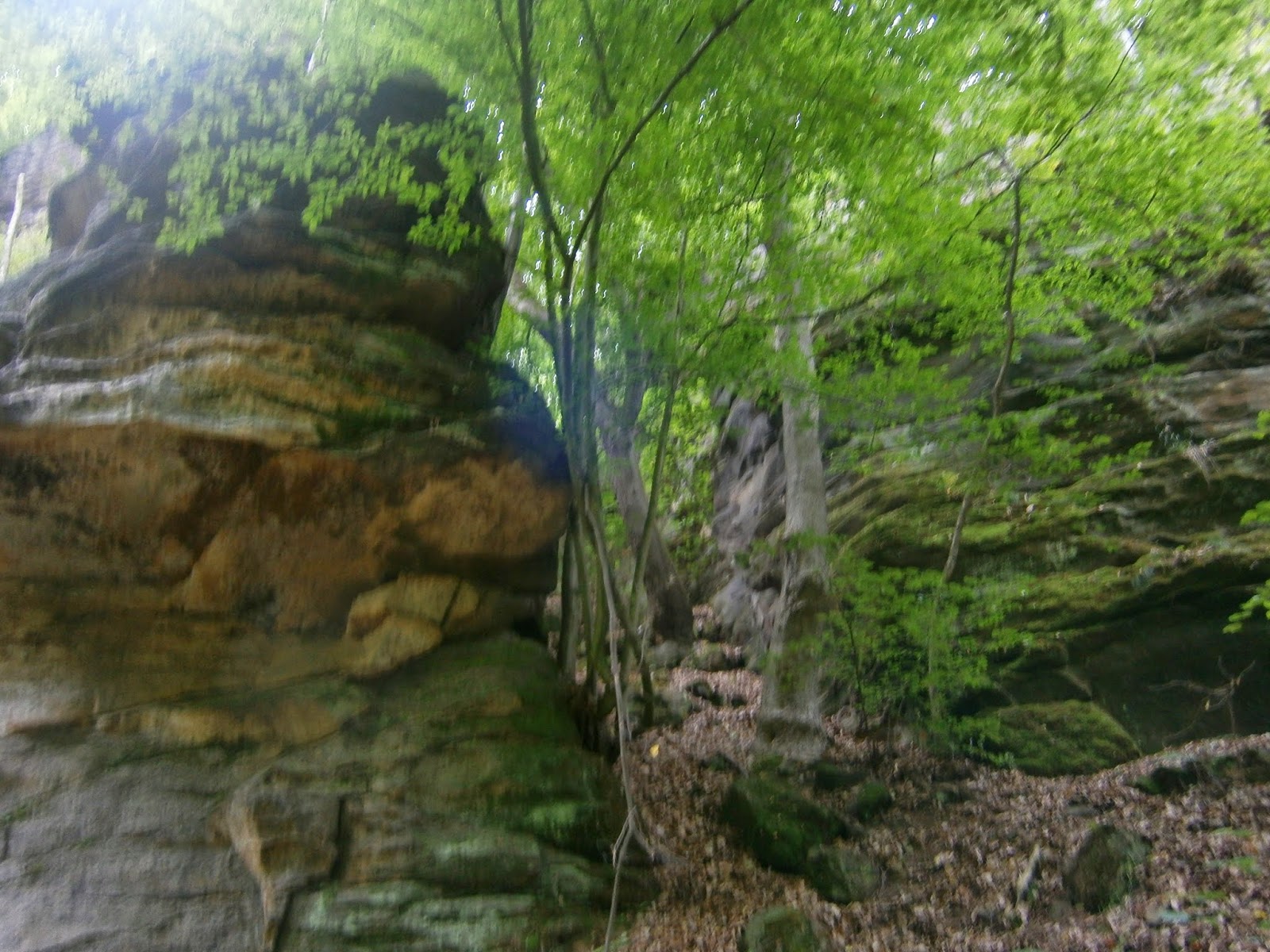
This path followed that same turbulent stream. The rocks rose higher and closer. The forest was thicker. I'd heard a few things about this monument, hidden deep in these woods.  An American Wagnerian had told me he found it 'creepy' because of its scale. It's the biggest Wagner monument in the world, standing 12.5 metres and, as he emphasized, was brought to this secretive spot in 1933. However, as Christian Muehne, the curator of the Lohengrinhaus pointed out, it had been planned to stand in Dresden but run into the usual city council conflicts. And even if it was installed when the Nazis were coming to power, they had not, he emphasized, paid a penny towards it.

Now I was drawing closer. I did not yet know if the monument was 'creepy' but the forest certainly was despite its beauty. I was alone in this dark chasm - the fisherman had followed at a safe distance but he was no longer visible so it was just me and the birds and the high dense trees and those immense rocks.

Wagner came here long before he wrote any of "The Ring" and it's tempting to think that when he walked here, those lofty rock summits inspired his "Walküre". His Siegfried would have found forest birds galore here although the busiest, most visible bird on my walk was a dipper, bobbing across rocks on the stream and diving down into the coppery depths.

I'd come to what looked like the end of the path. A small boardwalk with a rail, curved away from me and I increased my pace quite sure that I would turn this corner and confront 36 foot of difficult, complex, German genius.  But instead I was faced with a delapidated bridge across what was now a rushing river - and a locked gate with a sign that I now realized said more or less what the frowning fisherman had tried to tell me an hour earlier. T
he bridge was unsafe and crossing was forbidden . So there he was, the colossal  genius in stone - so near and yet so far.

Later that evening when I returned home and translated the rest of the sign, I understood that there had, in fact, been an easier route by driving further along the main road and taking a short walk and crossing another, safe bridge.  Oh well, Wagner always did make you work for his rewards. And, in one way or another, it is always worth it.


Thursday, 12 June 2014

The Schloss in Summer

 Writers and composers have always been drawn to high summer.  For me those two words conjure "The Go-Between" - the 1970 Pinter/Joseph Losey film of LP Hartley's novel of love between a high-born Edwardian lady,( Julie Christie) and the estate's game-keeper (Alan Bates.) The story plays out
through the long grasses of a Norfolk heatwave and ends in tragedy but not before it gives us one of the most erotic love scenes in cinema - and with not a trace of flesh on display.

Many quintessential high summer stories are lighter and gentler: Shakespeare's "Midsummer Night's Dream", Bergman's "Smiles of a Summer Night," and Woody Allen's  "Midsummer Night's Sex Comedy" all succumb to the crazy perfection of the longest days of the year when the grasses are high, the nights warm and our vulnerability to the elements is briefly gone. If you got stranded all night in a warm forest, or had to lie down in that long, warm, yellow grass, you risked little beyond a few insect bites. And so, for that brief moment, inhibitions can go too. All the characters in all those titles mentioned above find an excuse to lie down, usually with the wrong person, in that long, concealing grass.

Mid-summer is approaching at the Lohengrinhaus. The nights are warm, the meadows are full of high grasses that rustle in the summer breeze. The hedgerows are frothing with fragrant white philadelphus which fills the air with it's soft, creamy scent of orange-blossom It would be fun to link Wagner's work of mid-summer folly and love "Die Meistersinger von Nurnberg" and high summer here but that long, lovely tale of young and old love at the summer solstice was still years away when he stayed here. Mythical swans and knights were on his mind.  It would be even more fun to wonder whether he got to lie down in the high grass with the wrong person. But, unfaithful husband that he sometimes was, it seems that here in Graupa, his wanderings were restricted by circumstance if nothing else. He was here with first wife Minna, and life seemed to consist of composing, hiking and receiving visitors. Nevertheless walking through these same summer meadows, Wagner might have experienced some of those high-summer sensations - that feeling on a hot, still day that  time is suspended and that youth, and even life, might last forever.